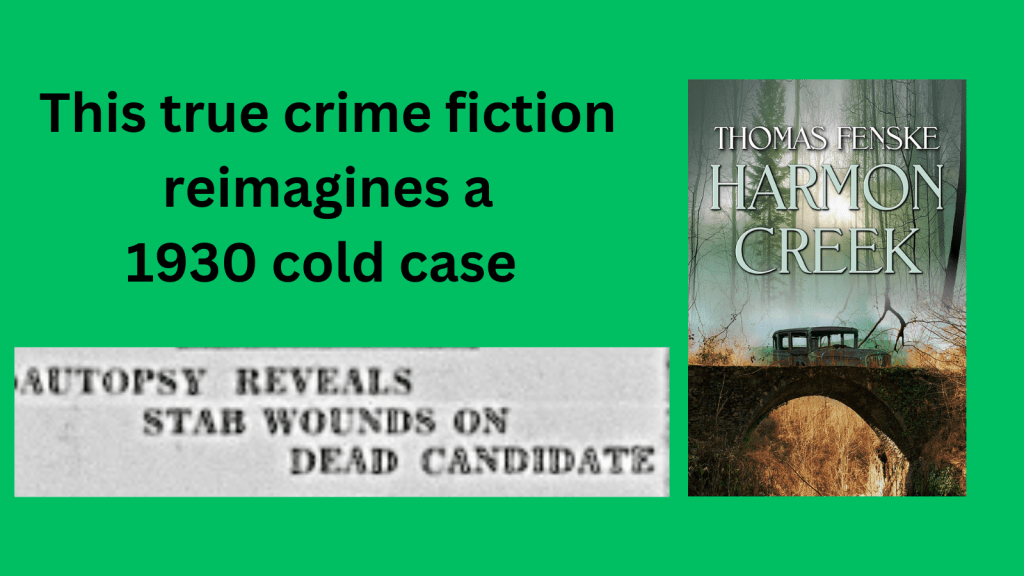
I created this graphic to promote my true-crime fiction HARMON CREEK. The story is written around a true event, the death of my wife Gretchen’s great uncle in 1930. Earl Swanger was a candidate for DA in a rural Texas county when he died mysteriously two weeks before the primary.
The death was officially declared an accident within 48 hours despite the three stab wounds found during the autopsy. He was found in his wrecked car near a bridge that crossed Harmon Creek.
Her family was devastated and always felt it was murder. The novel gives a fictional explanation for the events I uncovered through my research, as I attempt to answer the many unanswered questions that arose while reading the newspaper accounts
With the holidays approaching, I’m reminded of a bit of family history I read after the book was published. Gretchen found a family letter, written by Earl’s sister Pearl to Lily May Swanger, Earl’s widow. Pearl considered her sister-in-law to be her sister for the rest of their lives.
This letter was written Christmas Eve 1930, not six months after Earl’s death. Like most letters of the time, it’s full of chatty nuances about seasonal preparations and news of family members. But a few times she mentions the death.
Once, it’s to say she tries not to dwell on it and they shouldn’t mention it, evoking Depression-era stoicism. But she goes back to it again. A neighbor graciously lent her family a radio while the neighbor was out of town. She mentioned listening to a spiritualist’s radio show, and wishing she could contact him to ask him about Earl.
She then says something startling.
“I don’t think it was that woman at all, I think it was all political.”
In my research, one fact stood out. There was a woman mentioned, having at one point been in the car shortly before the ‘accident,’ but, she says, she got out to ride with another friend she realized was following them. Well, that was the first story. It changed two more times.
This woman is never mentioned by name, but one thing is obvious: she and her ‘friend’ were the last people to see Earl Swanger alive. Pearl’s little statement, validated my fictional premise, although in extension I figured the woman and man were players in the political intrigue that resulted in Earl’s death. That’s how I wrote it.
So this season, I’ll be thinking about Gretchen’s grandmother and great aunt’s continued grief during that 1930 Depression Christmas.
What really happened down by Harmon Creek? Read the book.
 Scratching the Surface