94 Years Ago Today

On July 9, 1930, an apparent one-car accident resulted in the death of a local attorney in Walker County, Texas. 
At the time of his death, Earl ‘Buddie’ Swanger was a candidate for district attorney in the upcoming primary election. His death was officially declared an accident within forty-eight hours, despite the medical examiner’s mention of stab wounds and reports of the mysterious involvement of a woman and man, both unnamed. The woman had apparently accompanied Swanger as he traveled to a campaign event. The woman admitted she had been a passenger in his car because she needed a ride. According to her first statement, she requested Swanger stop and let her out when she became aware her original ride was following them, but her story changed several times. Later statements involved alcohol and accusations of impropriety.

Swanger’s body was discovered in his car, which had rolled down an embankment on the approach to the new bridge spanning Harmon. Creek. This bridge was still under construction and stood adjacent to the old bridge. The local sheriff theorized the ‘stab wounds’ were the result of protruding nails from a smashed railing. The medical examiner begrudgingly changed his determination of murder under protest.

Although this candidate’s death generated a lot of statewide news interest, and the state dispatched a Texas Ranger to investigate, the woman and man were never named, and their changing stories were never fully corroborated. The news story lingered for a couple of weeks, then died just as surely as poor Earl Swanger had died on that steamy July night. 

Earl Swanger was my wife’s great-uncle and this story never left his family’s memory. Earl Swanger doted on his wife and was a chaste and sober man in all respects. Family letters confirm this. The presence of the woman in his car was out of character for him so there must have been some seemingly innocent explanation. Family letters also point to political intrigue and the family had no qualms about calling this a murder. It was 1930 and there is no reason to doubt the local political machine was corrupt and this was what had prompted Earl to run for office. But people in this time also didn’t push back as much as they do now. Life went on, with or without justice.

My novel HARMON CREEK takes a new look at this incident, creating a fictional backdrop to explain many of the questions that arose in my mind while researching the news accounts of the day. My fictional premise revolves around motive: I think the murder was likely an incidental result of a different plan entirely, a plan that went very wrong. In this fictional account, the corrupt incumbent, intent on holding onto his personally lucrative office, sought to subtly discredit his opponent with an illusion of impropriety, recruiting a small-time petty crook to do just that, lured with the promise of deferred prosecution. 

But these things are never quite as simple as they seem and after the woman managed to get into Swanger’s car using some ruse, something went wrong. Prostitutes of the time were often armed with ice picks. They were small and light, easily concealed, and easy to use. The DA’s coercion was a strong motivator, so fear of failure would have been enough motivation for her to panic and then threaten Earl to keep driving, then to lash out at him when he balked. This certainly would have caused Earl to swerve and stop. Her boyfriend, part of the conspiracy and following closely behind, would have stopped as well and it is easy to assume a confrontation ensued. Of course, it did not end well for poor Earl Swanger, leaving these two with one more problem: What do they do now?

Stage a wreck and then drive off, of course

The thing about conspiracies is the fact that what the planners want most of all is to cover their tracks. Complications must be dealt with. The actors are criminals after all, and more crimes are the most expedient solution to criminals, especially regarding loose ends. And they didn’t even know about the eyewitness. Yes, there was an eyewitness, Claude, a local black man, who was a recent client of attorney Swanger. When the two murderers drive off Claude rushes to aid the mortally wounded Swanger.

Before he dies, Swanger implores Claude to protect his wife, and to keep quiet about what he saw, because he’ll be blamed for the death if he comes forward with what he saw. 

This is where the story in HARMON CREEK really takes off: the death of Earl ‘Buddie’ Swanger was a catalyst for what was to follow. True crime or crime fiction? How about a little of both?

HARMON CREEK is available in all eBook formats and is also available in paperback. Look for it on Amazon or you can get your favorite bookstore to order it.

https://books2read.com/u/mYQPdw

Turning Truth Into Fiction

Harmon Creek opens with a man sitting uncomfortably in court. We find out his name is Claude, and Earl Swanger is his attorney. Claude is a black man at odds with the world he lives in. He was arrested for petty bootlegging during prohibition and the sitting District Attorney is prosecuting him like a hardened criminal. Why? Because Claude is represented by his opponent in an upcoming election.

Claude is not part of the real story, at least as far as I know, but he’s based on a real person. My wife knew the real Claude much later when she’d visit the house of Earl’s widow, Lily May. He was a common presence in the house and on the property. The two had an interesting relationship. Well, relationship is probably the wrong word because there was nothing romantic here. He was a neighbor who had an uncommon devotion to “Miss Lily May” … he was more friend than a handyman and he certainly did a lot of work for her, but for the mid-Twentieth Century in a racially divided America it was certainly a kind of Driving Miss Daisy sort of friendship. Knowing this man was one of my wife’s fondest memories of her visits.

I have always been intrigued by this notion, so I endeavored to add Claude to the equation to perhaps inject some sense to it, at least in my mind. Also, the character Claude adds a great deal of depth to the story and creates a side-story that interweaves with the rest of the novel to make it more compelling, or at least I hope so. In most ways, it is as much Claude’s story as it is Earl’s.

Although the family thought Earl’s death was outright murder, after digesting as many facts as I could, I didn’t think so. I’ve studied murders and although some are cut and dried, most revolve around something quite different, more likely a misunderstanding that got out of hand.

Some of the later witness statements devolved into insinuations by the mysterious woman that Earl had perhaps been drunk or possibly had been behaving inappropriately with her. She apparently changed her story several times, with each iteration becoming more prone to the latter notion.

Please understand, I’ve read family letters both from him and about him, and this man was a nice guy, not prone to cheat on his wife, certainly not a drunk, and anyway, to do so in the middle of a campaign would be political suicide. I also didn’t think an incumbent would be so stupid as to assassinate an opponent. It’s too obvious.

Cheating? I mean, this was a small town, and Miss Lily May was out campaigning for Earl in another section of the district. It was getting into the final stretch. No, this was out of character for this guy.

Ah, but a setup…that would work. Even a somewhat dirty DA wouldn’t be above hiring someone to lure his opponent into the appearances of impropriety. Once I created this premise, the rest of it pretty much wrote itself. I had a backdrop of truth to paint my story against and the increasingly sordid tale meandered across several of the complications that naturally follow these types of crimes.

It’s an old motif. Witnesses who can’t keep quiet, or who you can’t trust completely, must be kept quiet by whatever means. And if the DA is dirty, he’s probably in cahoots with organized crime, which wasn’t just active in Chicago and New York; Huntsville TX sits within the range of a major organization operating out of Galveston at the time. Similar operations existed in Dallas and New Orleans. It makes sense that if there is unwanted attention in even a backwoods part of the operation, it is in these organization’s best interest to help smooth the waters and, if necessary, help each other in the process.

I don’t want to spoil the fun … you’ll just have to read it!

==========================

Thomas Fenske is a novelist living in North Carolina.

Look for HARMON CREEK in June 2022 on Amazon or ask your favorite bookstore to order it.
http://tfenske.com

… My New Release – Phase II

First things first. I realized after pushing out my last post that I neglected a few things about web site development. I’m trying to remember the first web site I created, but it was way back. 1992 or 1993. You read that right. I had a web site before most people knew the wide wide world of webs even existed. I created it by hand. I remember a colleague who I shared it with asked me “what book did you use?”

I blinked. “Book?”

Anyway, using tools to build websites is a new thing. And moving to a single page format like my cheap new web hosting site requires a bit of tweaking to get it right. But I can use things through links. Like it links this blog just great. And I have a perfectly good Amazon Author Page out there, listing all of my books. They pay developers six figure salaries to do a better job than I could ever do with my multiple book pages on my old site.

Enough about that. Here I am a little more than five weeks out and I am slowly gearing up my massive marketing machine. That’s how it feels sometimes. I often tell people that writing a novel is hard, revising the manuscript is harder, and marketing the sucker kicks me in the ass. Yet, with this being my sixth novel, I’ve learned a few things.

There are plenty of people waiting in the wings just dying to take my hard earned money and help me market my new release. I call most of them “preaching to the choir” services. They prey upon authors and, sadly, most of their focus is to other authors. Now, don’t get me wrong, I know that in order to be a good author one must read a lot. But in my experience, most newer authors don’t read very much in the realm of other newer authors. Some do, (and I love you very much) but most don’t.

Then there is the whole eBook/print book thing. My small press is geared primarily toward eBooks, although print books are available and, more recently, available at places beyond Amazon. More on that later. I still don’t understand the aversion to eBooks. I’ve actually read more since I embraced eBooks than I had for years. My Kindle App is loaded on both my tablet and my phone, and it keeps my place on both. If you’ve ever been stuck waiting some place and wish you had something besides a two year old weathered magazine to read, well, pull out your phone and you can just start reading.

Anyway, the key to actually making money in the book biz focuses on getting your books into bookstores. It’s a tough nut to crack for unknown authors. I worked in scholarly publishing for 20+ years and can tell you this: you have to be able to carpet bomb them and that takes capital. See, when bookstores order twenty copies of your book in the hopes that it will sell, they expect that they will be able to return the unsold stock for full credit if the books don’t sell. Huge publishers absorb this cost of doing business. For every best seller they likely have dozens of not-so-best-sellers. Small presses and Indie authors can not compete on a national level so we have to resort to … well, whatever the hell we can.

Here. Now. Me. This. This is what I am doing here, trying to entertain you in a lame attempt to get you to remember my name and even better, my new release, HARMON CREEK. See what I did there? I put in a link. New authors take note. EVERY TIME YOU MENTION YOUR BOOK, put in a link. I don’t have a sales link yet, so I put in a link to a book page I set up on my old website. I have lost count of the book tweets and Facebook posts with authors mentioning “my new book” and they will say “available at Amazon” … yet NO LINK! I should already be navigating there. I guess I should search for you or your book? Really?

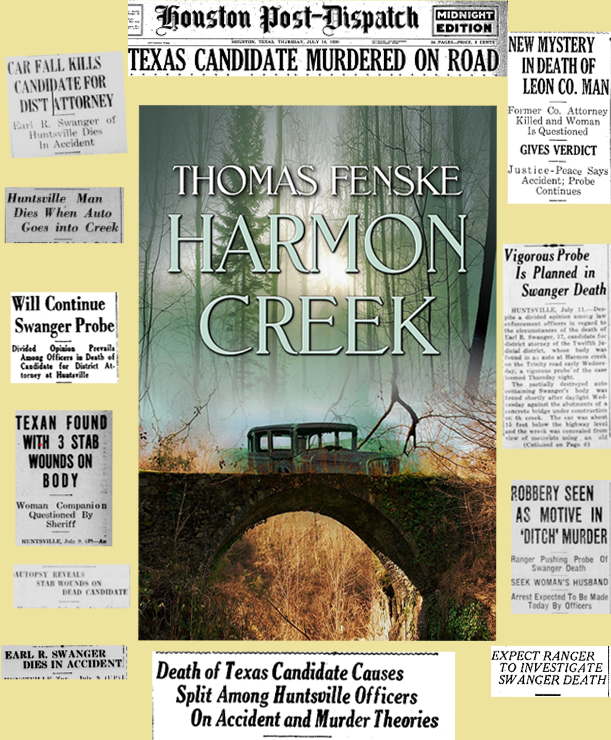
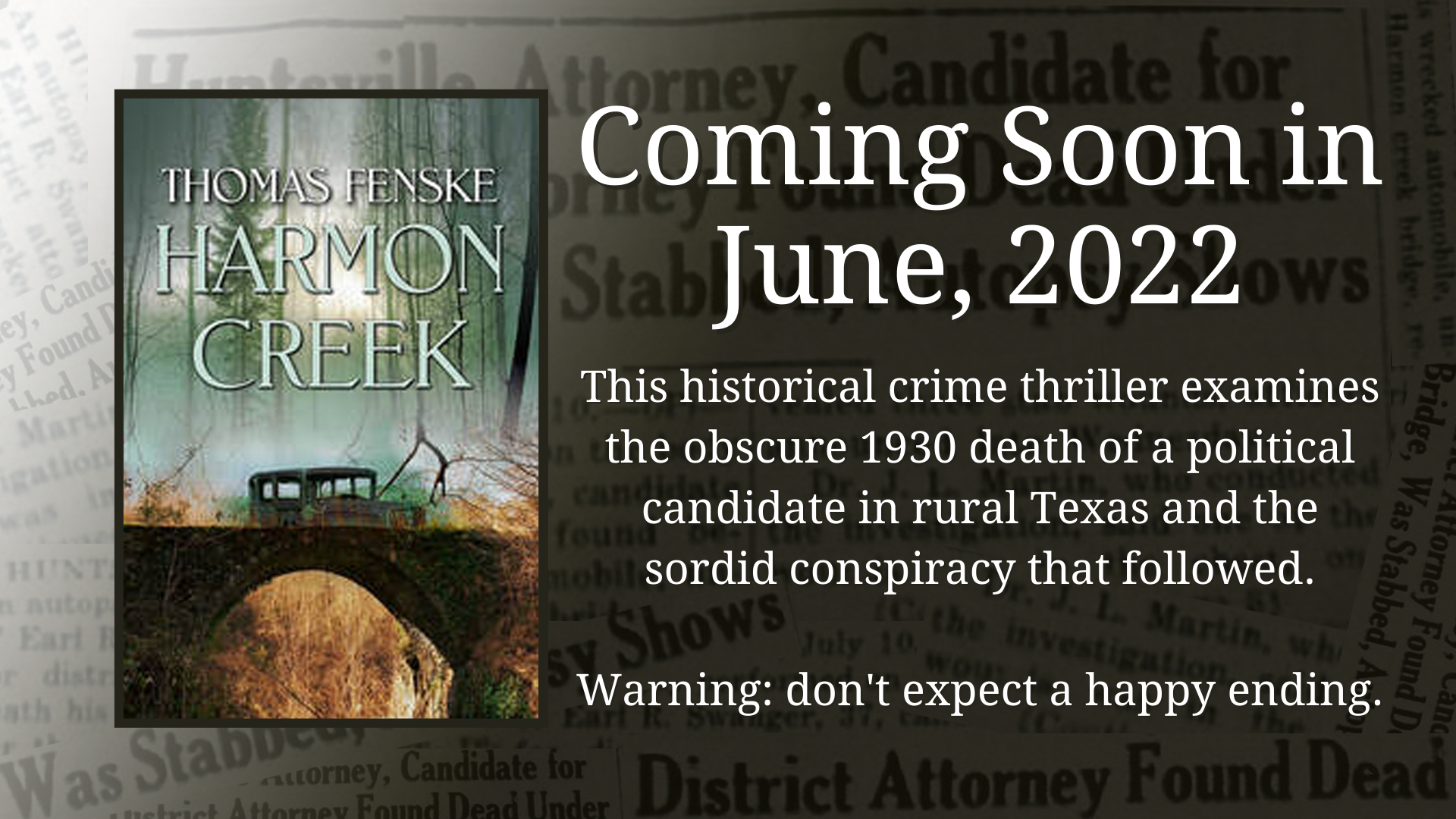
Another thing that helps is catchy graphics. Believe it or not, that was originally the purpose of this post, to illustrate the importance of catchy graphics. I’m a writer, not a graphic artist. I do, however, have visual representations that pop into my punkin haid from time to time. All of my book covers were first conceptualized by me. Thankfully, all but one were actually designed by someone who knew what they were doing. The lone cover I designed myself is my free cookbook (companion to my adventure mystery series) and it shows. But I think it matches the cookbook itself, which was designed to mimic the type of local self-produced cookbooks one might find in a rural cafe in the 1980s. I collect vintage cookbooks, I know that genre well. What I came up with, in my lame and crude attempt at design was this:

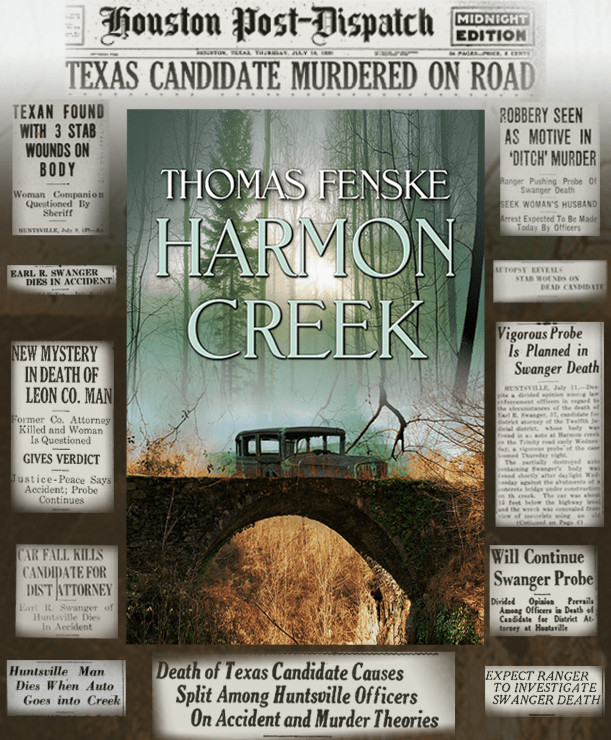
My book cover, surrounded by true life headlines relating to the primary subject matter of the book itself. Not too bad but I knew it could be better. Enter my awesome and talented daughter Audrey. Dancer turned social media expert that she is, she took my photoshop file and made it into something truly inspiring:

Same cover photo, same headlines, but she knew how to do things I did not and she made it both visually stunning and, well, amazing.

So, basically, what I wanted people to know was that the book is based on a true story. It’s personal to our family as well, the subject was her great-great uncle, her mother’s great uncle. I’ll be sharing more about the back story in coming posts, so stay tuned.

===========================

Thomas Fenske is an author living in North Carolina. More information here: https://tfenske.com