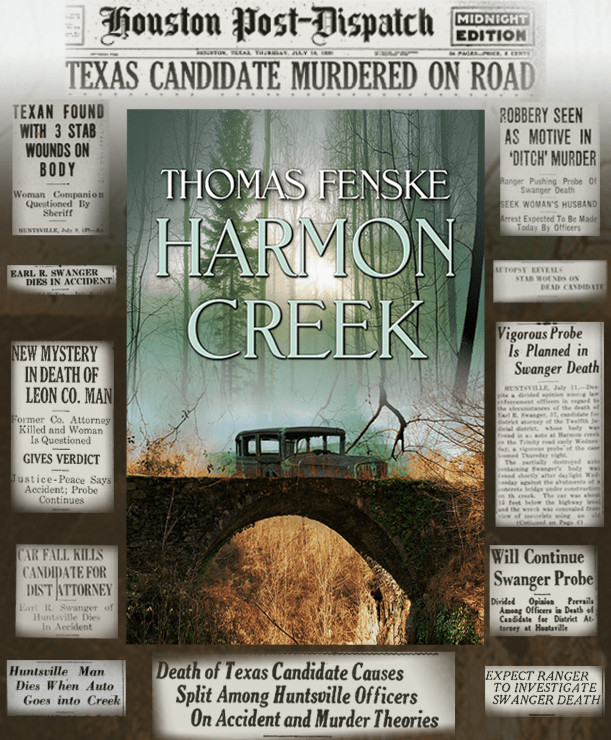
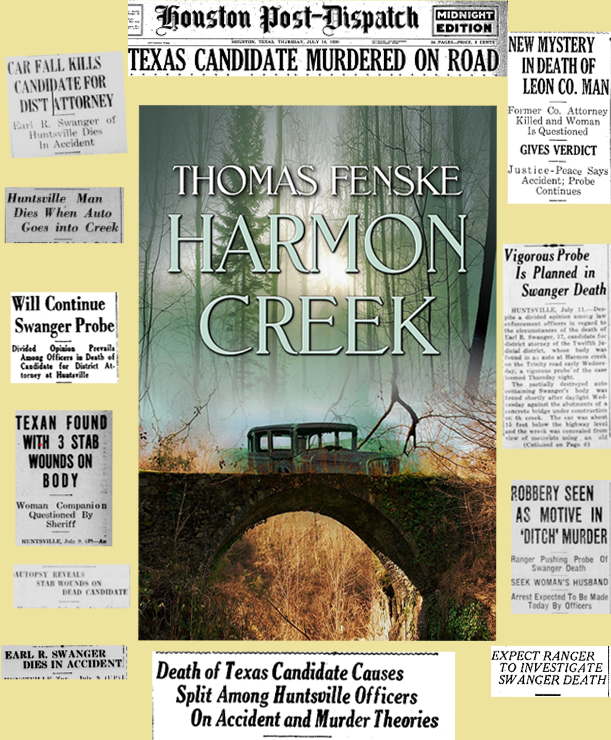
On July 9, 1930, an apparent one-car accident resulted in the death of a local attorney in Walker County, Texas.

At the time of his death, Earl ‘Buddie’ Swanger was a candidate for district attorney in the upcoming primary election. His death was officially declared an accident within forty-eight hours, despite the medical examiner’s mention of stab wounds and reports of the mysterious involvement of a woman and man, both unnamed. The woman had apparently accompanied Swanger as he traveled to a campaign event. The woman admitted she had been a passenger in his car because she needed a ride. According to her first statement, she requested Swanger stop and let her out when she became aware her original ride was following them, but her story changed several times. Later statements involved alcohol and accusations of impropriety.
Swanger’s body was discovered in his car, which had rolled down an embankment on the approach to the new bridge spanning Harmon. Creek. This bridge was still under construction and stood adjacent to the old bridge. The local sheriff theorized the ‘stab wounds’ were the result of protruding nails from a smashed railing. The medical examiner begrudgingly changed his determination of murder under protest.
Although this candidate’s death generated a lot of statewide news interest, and the state dispatched a Texas Ranger to investigate, the woman and man were never named, and their changing stories were never fully corroborated. The news story lingered for a couple of weeks, then died just as surely as poor Earl Swanger had died on that steamy July night.
Earl Swanger was my wife’s great-uncle and this story never left his family’s memory. Earl Swanger doted on his wife and was a chaste and sober man in all respects. Family letters confirm this. The presence of the woman in his car was out of character for him so there must have been some seemingly innocent explanation. Family letters also point to political intrigue and the family had no qualms about calling this a murder. It was 1930 and there is no reason to doubt the local political machine was corrupt and this was what had prompted Earl to run for office. But people in this time also didn’t push back as much as they do now. Life went on, with or without justice.
My novel HARMON CREEK takes a new look at this incident, creating a fictional backdrop to explain many of the questions that arose in my mind while researching the news accounts of the day. My fictional premise revolves around motive: I think the murder was likely an incidental result of a different plan entirely, a plan that went very wrong. In this fictional account, the corrupt incumbent, intent on holding onto his personally lucrative office, sought to subtly discredit his opponent with an illusion of impropriety, recruiting a small-time petty crook to do just that, lured with the promise of deferred prosecution.
But these things are never quite as simple as they seem and after the woman managed to get into Swanger’s car using some ruse, something went wrong. Prostitutes of the time were often armed with ice picks. They were small and light, easily concealed, and easy to use. The DA’s coercion was a strong motivator, so fear of failure would have been enough motivation for her to panic and then threaten Earl to keep driving, then to lash out at him when he balked. This certainly would have caused Earl to swerve and stop. Her boyfriend, part of the conspiracy and following closely behind, would have stopped as well and it is easy to assume a confrontation ensued. Of course, it did not end well for poor Earl Swanger, leaving these two with one more problem: What do they do now?
Stage a wreck and then drive off, of course
The thing about conspiracies is the fact that what the planners want most of all is to cover their tracks. Complications must be dealt with. The actors are criminals after all, and more crimes are the most expedient solution to criminals, especially regarding loose ends. And they didn’t even know about the eyewitness. Yes, there was an eyewitness, Claude, a local black man, who was a recent client of attorney Swanger. When the two murderers drive off Claude rushes to aid the mortally wounded Swanger.
Before he dies, Swanger implores Claude to protect his wife, and to keep quiet about what he saw, because he’ll be blamed for the death if he comes forward with what he saw.
This is where the story in HARMON CREEK really takes off: the death of Earl ‘Buddie’ Swanger was a catalyst for what was to follow. True crime or crime fiction? How about a little of both?
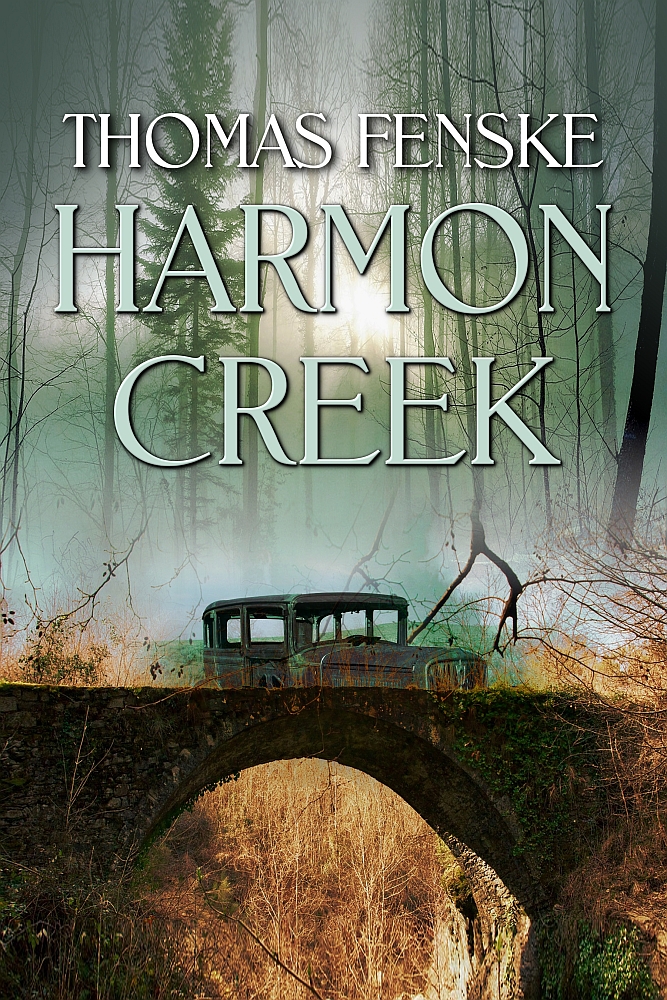
HARMON CREEK is available in all eBook formats and is also available in paperback. Look for it on Amazon or you can get your favorite bookstore to order it.

 This Civil War memoir explores fifteen-year-old Jack Benson’s transition to manhood as he presents his soldier’s account of life in the Confederate cavalry, a life convoluted by the spectral manipulations of Vanita, an old witch-woman who is sworn to safeguard him. Her hidden presence seems to protect Jack throughout the war in amazing ways, across countless miles, through patrols, battle, and capture.
 If we were having coffee today I’d admit I didn’t have much to talk about today until I read the lead-in WeekendCoffeeShare posting from
  Anyway, it’s fall, and I am once again thinking about my novel,
 Scratching the Surface